
 | Prof. Ali Cheshmehzangi Beijing University of Technology, China Ali Cheshmehzangi is a Professor at the School of Architecture, Design and Planning, University of Queensland, leading research in architecture, design, and urbanism. Recognized by Stanford University as a top 2% global field leader for two consecutive years and among the top 30 scholars in urban sustainability, he is internationally known for his work on climate resilience and sustainable urbanism. Ali serves as Editor-in-Chief of Springer’s Urban Sustainability book series and holds five academic degrees, including a PhD in Architecture and Urban Design. He has extensive university leadership experience and holds honorary roles at Hiroshima University’s Network for Education and Research on Peace and Sustainability (NERPS). Ali collaborates with major organizations such as the Asian Development Bank, UN-Habitat, ICLEI, Arup, Siemens, and others. He supervises numerous PhD students in urban sustainability and built environment research and welcomes new candidates interested in impactful, applied research. Ali is active internationally across Australia, Asia, Europe, North America, and Africa, focusing on meaningful research that benefits local communities with global perspectives. He has published over 500 papers and 26 books on sustainable urban development, with several receiving national and international awards, including recognition for his contributions to urban resilience and higher education. |
 | Prof. Sangeeta Singh Institute of Engineering, Nepal Prof. Sangeeta Singh is a senior professor at the Institute of Engineering, Nepal. She has long been engaged in the research fields of urban planning, eco-city construction, disaster resilience and sustainable development. With decades of experience in university teaching, academic research and administrative management, she also serves as the person in charge of the university’s research center. She once worked for the National Planning Commission of Nepal to participate in the formulation of national development plans. She actively promotes international academic exchanges and cross-border research cooperation, devotes herself to engineering education innovation and gender mainstreaming research. She has published a number of high-level academic papers and been invited to deliver speeches at many international conferences, enjoying high academic influence in the field of sustainable urban planning in South Asia. |
| Assoc. Prof. Bin Hu Beijing University of Technology, China Hu Bin, born in June 1972, graduated from the School of Architecture at Harbin Institute of Technology in 2002,majoring in Architecture. He holds a PhD, associate professor, and master's supervisor. He is also the director of theUnderground Space Planning and Design Research Institute at Beijing Institute of Technology, a national first-classregistered architect, and the deputy chief architect of the school's design institute. Young and middle-aged backboneteachers in Beijing, outstanding talents in the Organization Department.Main research areas: public building design and theory, urban design, underground space planning and design, railtransit and urban integration development, etc. Engaged in architectural design and urban design theory and practice forover 20 years. Responsible for and participated in more than 10 national, provincial, and ministerial level scientificresearch projects, including the National Natural Science Foundation of China, the Beijing Municipal Natural ScienceFoundation of China, the Beijing Municipal Education Commission Fund, and the Beijing Municipal Planning and Self Commission Special Topics. Published over 50 papers as the first author, including more than 20 papers in the corejournals of Peking University. |
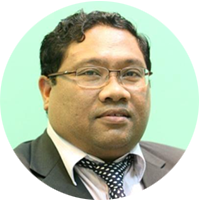 | Assoc. Prof. Zawawi Bin DaudUniversiti Tun Hussein Onn Malaysia, Malaysia Dr. Zawawi Daud works as an Associate Professor at Faculty of Civil and Environmental Engineering, Universiti Tun Hussein Onn Malaysia. Born and trained in Malaysia, he has a bachelor’s degree in Civil Engineering (University of Technology Malaysia), a master’s in Civil Engineering (Environment) (University of Technology Malaysia), and a doctorate in Environmental Engineering (University of Science Malaysia). Dr. Zawawi teaches various courses related to environmental engineering, management and science at undergraduate and masters levels. These include water and wastewater treatment, biological and physico-chemical treatment processes, sludge management, industrial and hazardous waste management and water quality management. Dr. Zawawi’s research focuses on alleviating problems associated with water pollution issues from industrial wastewater and landfill leachate. His latest interest is on natural adsorbent material in water and wastewater treatments. |
